


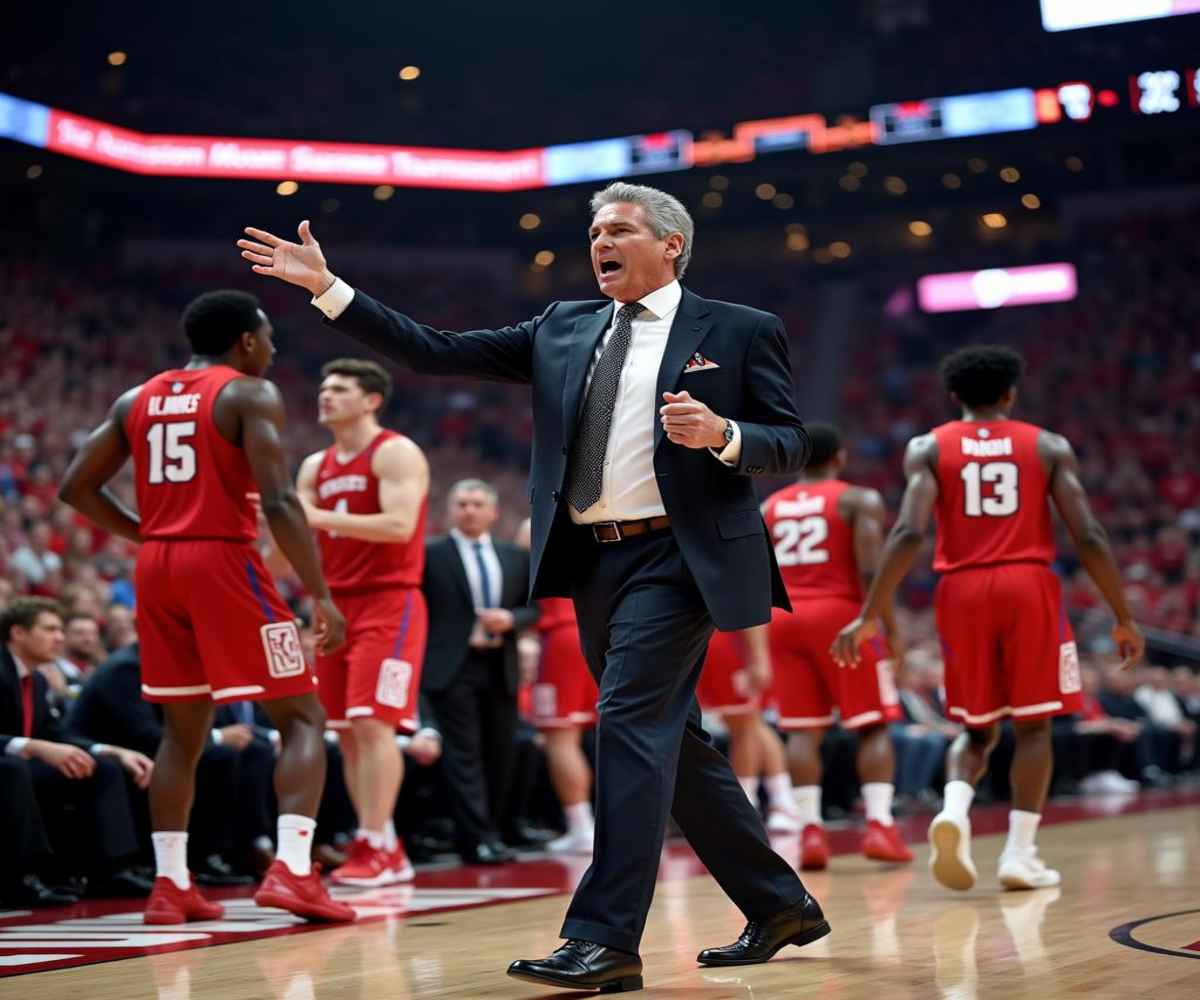
When Rick Pitino took the helm at St. John’s in 2023, skeptics questioned whether the 72-year-old coaching legend could revive a program that hadn’t won an NCAA Tournament game since 2000. Two seasons later, he’s silenced the doubters—and then some. Fresh off being named Big East Coach of the Year, Pitino has orchestrated one of the most dramatic turnarounds in college basketball, leading the Red Storm to their first Big East Tournament title in 25 years and positioning them as a legitimate Final Four threat. But how did he do it? And can St. John’s, now a projected No. 2 seed, sustain this momentum deep into March Madness? Let’s unpack the resurgence.
The Pitino Effect: A Masterclass in Program Building
Pitino’s impact transcends X’s and O’s. At St. John’s, he’s blended old-school discipline with modern roster construction, leveraging the transfer portal to assemble a roster that’s equal parts toughness and finesse. The results speak for themselves: a 25-7 regular-season record, an outright Big East regular-season title, and a dominant 82-66 thrashing of Creighton in the conference tournament final, as detailed by the Big East’s official recap. This wasn’t just a victory—it was a statement. The Red Storm held Creighton, a top-10 offensive team, to 35% shooting, showcasing Pitino’s trademark defensive intensity. “We’re not here to compete,” Pitino declared postgame. “We’re here to cut down nets.” That swagger has trickled down to his players, transforming St. John’s from afterthought to apex predator.
RJ Luis Jr.: The Engine of a New Era
Central to this revival is RJ Luis Jr., the Big East Player of the Year and the team’s emotional catalyst. A 6’7″ wing with a scorer’s mentality and a lockdown defender’s grit, Luis dropped a double-double (18 points, 11 rebounds) in the championship game, per Sporting News. But his value extends beyond stats. Luis embodies Pitino’s philosophy: relentless on-ball pressure, unselfish passing, and clutch shot-making. In a December non-conference win over Kansas, he drained a step-back three with 12 seconds left to seal the upset—a moment that foreshadowed St. John’s March potential. Alongside him, transfers Kadary Richmond (a double-double machine) and Zuby Ejiofor (20 points in the title game) have given the Red Storm a balanced attack that’s top-20 in both offensive and defensive efficiency. This isn’t a team reliant on one star; it’s a symphony of skill sets fine-tuned by Pitino’s baton.
The Big East Blueprint: Defense, Depth, and Durability
What separates this St. John’s squad from previous iterations? Depth. Pitino’s rotation goes nine deep, with reserves like sharpshooter Brady Dunlap and rim protector Joel Soriano providing sparks off the bench. This allows the Red Storm to maintain their trademark full-court press for 40 minutes, wearing down opponents into costly turnovers. In the Big East Tournament, they forced 15.3 giveaways per game—a key reason they cruised to the title. But it’s not just chaos for chaos’ sake. As OutKick notes, Pitino has instilled a “positionless” defensive scheme where switches are seamless, and help rotations are instantaneous. The result? St. John’s ranks 12th nationally in defensive effective field goal percentage, stifling even elite offenses like UConn and Marquette.
The March Mandate: Why This Year Feels Different
St. John’s hasn’t reached the Final Four since 1985, but 2025 offers their best shot in decades. As a projected No. 2 seed, per 247Sports, they’ll avoid juggernauts like Houston or Purdue until the Elite Eight. Their path is further smoothed by Pitino’s March pedigree: two NCAA titles, seven Final Fours, and a knack for peaking when it matters. Critics point to their reliance on three-point shooting (36% as a team) as a potential flaw, but this roster is built for versatility. When shots aren’t falling, they can pound the ball inside to Ejiofor or attack the rim with Luis and Richmond. And let’s not forget Pitino’s psychological edge—he’s a maestro at prepping for high-pressure moments, as seen in his legendary Louisville and Kentucky runs.
The Road Ahead: Can History Repeat Itself?
The last time St. John’s entered the tournament with this much hype, Walter Berry and Chris Mullin were leading the charge. Four decades later, the program stands at a similar crossroads. With Pitino’s system clicking and a roster oozing confidence, the Red Storm aren’t just chasing a Sweet 16—they’re eyeing history. But challenges loom. Can they handle the physicality of Big Ten bruisers? Will their depth hold up against faster-paced teams? And can Luis, a first-time March participant, stay composed under the brightest lights?
In part two, we’ll dive into St. John’s potential bracket matchups, analyze their Achilles’ heel (late-game free-throw shooting), and explore how Pitino’s past title runs could foreshadow this team’s ceiling. One thing’s certain: after 25 years of irrelevance, St. John’s is back. And they’re not sneaking up on anyone.
### Bracket Breakdown: Navigating the Path to Phoenix
St. John’s projected No. 2 seed places them in the East Region, potentially setting up a second-round clash with a physical mid-major like Long Beach State or a streaky Colorado squad that ranks top-40 in three-point efficiency. While neither team boasts the depth to handle St. John’s relentless press for 40 minutes, Pitino has emphasized the importance of respecting every opponent. “In March, it’s survive and advance—no style points,” he told OutKick after the Big East title game. A Sweet 16 matchup could pit the Red Storm against SEC powerhouse Alabama, a team that plays at the nation’s fastest tempo but struggles defensively (98th in adjusted efficiency). This would be a clash of philosophies: St. John’s methodical half-court sets vs. Alabama’s transition chaos. However, the Crimson Tide’s porous interior defense (290th in rebounding) plays directly into the hands of Zuby Ejiofor and Kadary Richmond, who combined for 32 paint points in the Big East final.
The Elite Eight looms as the ultimate litmus test. A potential showdown with No. 1 seed Houston—a defensive juggernaut allowing just 57.3 points per game—would test St. John’s offensive creativity. Houston’s switch-everything scheme neutralizes pick-and-roll actions, but Pitino’s motion-heavy offense, which prioritizes off-ball screens and quick reversals, could exploit gaps. RJ Luis Jr.’s ability to create mid-range looks against Houston’s top-ranked perimeter defense (247Sports projects this as a 60-40 battle in Houston’s favor) might decide who cuts down the nets.
### The Achilles’ Heel: Late-Game Free-Throw Woes
For all their strengths, St. John’s late-game execution raises eyebrows. The Red Storm shoot just 68.9% from the charity stripe (227th nationally), a flaw that nearly cost them the Big East semifinal against UConn. Up three with 18 seconds left, Brady Dunlap missed the front end of a 1-and-1, allowing the Huskies to force overtime on a buzzer-beating three. While St. John’s escaped, Pitino acknowledged the issue: “We’ve got ice in our veins until we step to the line,” he quipped to Sporting News. The numbers are stark: in games decided by five points or fewer, St. John’s is 3-3, with missed free throws contributing to all three losses.
This vulnerability becomes magnified in single-elimination play. Consider Purdue’s 2023 NCAA Tournament exit: a 64% free-throw shooting team, they crumbled under pressure, missing key late attempts against Fairleigh Dickinson. St. John’s must avoid a similar fate. The solution? Pitino has leaned on late-game simulations in practice, forcing players to shoot free throws while exhausted—a tactic he famously used at Louisville before their 2013 title run. If Luis (74% FT) and Richmond (69%) can elevate their composure, St. John’s transforms from vulnerable to invincible in crunch time.
### Pitino’s Playbook: Lessons from Past Title Runs
Pitino’s 1996 Kentucky team and 2013 Louisville squad share DNA with this St. John’s roster. The ’96 Wildcats used a 10-man rotation to overwhelm opponents with full-court pressure, forcing 18.7 turnovers per game—a blueprint mirrored by this year’s Red Storm (16.1 takeaways/game). Meanwhile, the 2013 Cardinals thrived on defensive versatility, ranking 1st in block rate and 3rd in steal rate. St. John’s current metrics (12th in blocks, 8th in steals) suggest similar potential.
But Pitino’s greatest March asset might be his adaptability. In 2013, after losing guard Kevin Ware to a horrific leg injury, he reconfigured Louisville’s offense around Gorgui Dieng’s post play—a pivot that delivered a title. This season, when three-point specialist Simeon Wilcher suffered a midseason ankle sprain, Pitino shifted to a rim-attacking scheme that produced six straight wins. “He’s got a Plan B, C, and D for every scenario,” noted Big East.com analyst John Fanta.
### The Verdict: Storm Clouds Gathering Over March
As Selection Sunday approaches, St. John’s isn’t just chasing wins—they’re chasing legacy. Forty years after Mullin’s iconic run, the Red Storm have the coach, the roster, and the defensive identity to rewrite history. Yes, free-throw jitters and bracket landmines lurk, but Pitino’s teams have always thrived as underdogs-turned-overlords. The 2025 season isn’t merely a resurgence; it’s a reckoning. Every defensive stop, every RJ Luis step-back, every Pitino timeout—it all converges toward one question: Can New York’s sleeping giant finally awaken in March? The nation’s eyes are on Queens. The nets? They’re already halfway cut.